


Summary
The position of women in the labour market from the onset of the economic crisis until today, despite individual variations, has not changed significantly. Low female participation in the labour market, inequality of opportunity, reduced prospects for career advancement, the multiplicity of their roles, the inability to reconcile work and family life, and their insufficient participation in decision-making processes and in actions to upgrade their qualifications continue to be among the most critical issues they face over time. In addition, the domestic sphere contributes decisively to the formation
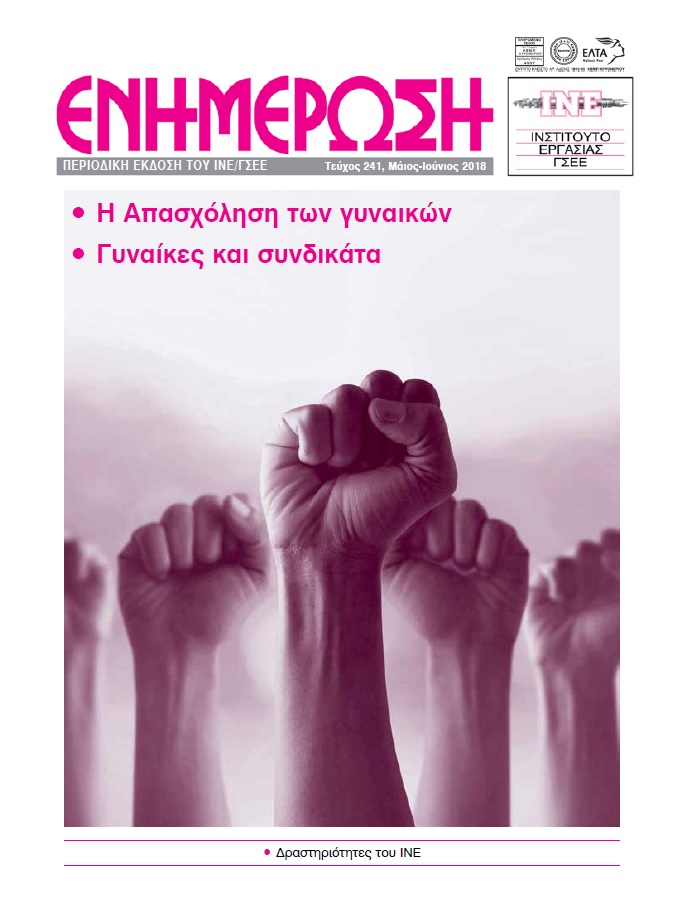
and perpetuation of the division of the labour market into two segments: an “upper” segment in which “secure” workers participate, and a “lower” segment in which women participate en masse, alongside young people, migrants, and generally all workers with low expectations. Furthermore, the precarious nature of women’s participation in employment makes their representation in trade unions even more difficult, combined with obstacles stemming from stereotypes that reinforce specific beliefs, values, and perceptions regarding the role of women, which in turn foster a self-deprecating consciousness regarding their participation in public life. These, among others, are some of the conclusions drawn in both the article entitled “Women’s Employment and Unemployment” and the article entitled “Trade Unions and Women”, which are published in this issue of ENIMEROSI. Finally, ENIMEROSI publishes the recent activities of the Labour Institute (INE).