


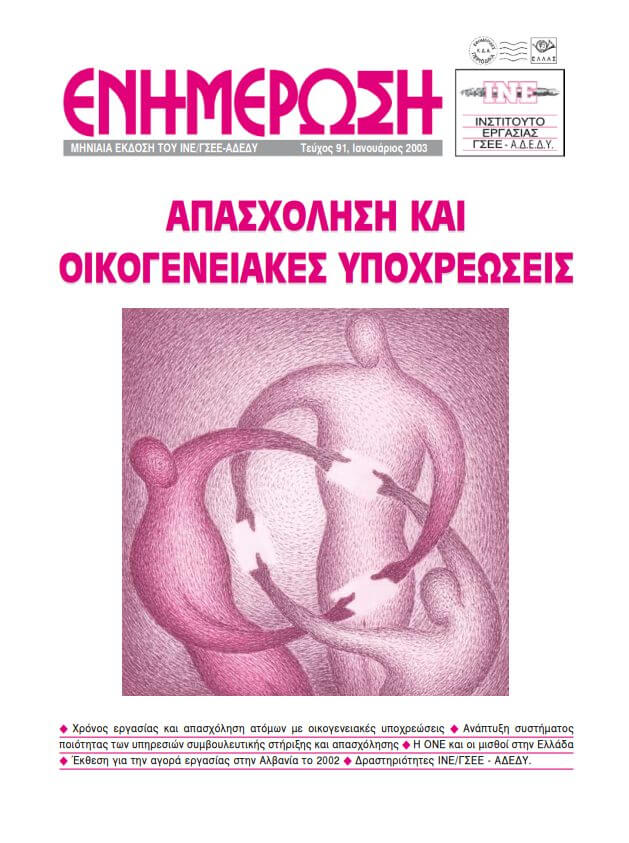
Summary
The organisation and management of working time constitutes the resultant of state policies for the family and the labour market. Working time and employment systems are a central point of reference for labour market policies, as well as for family strategies, significantly affecting the functioning and position of the family within the broader socio-economic system. The family and the labour market have essentially never been two “worlds apart” and alien to each other. Processes within one have affected, and continue to affect, developments within the other. Consequently, the relationship among the three levels—State, family, and labour market—is largely determined by their internal dynamics and assumes characteristics that indicate both a competitive relationship and, at the same time, a relationship of interdependence. In this issue, ENIMEROSI presents an article on the employment of persons with family responsibilities, as well as articles regarding: the Development of a Quality System for Guidance Support and Employment Services, the EMU and wages in Greece, and furthermore, an article on the report regarding the labour market in Albania in 2002. Finally, ENIMEROSI presents the recent activities of INE/GSEE-ADEDY.